
Climbing Mount Aristotle
A Report on the Ascent in Progress

Yesterday morning I wrapped up a 48-hour writing sprint in which, after several weeks of concentrated research and reflection, I composed chapter four (on love and friendship) of my forthcoming book on Aristotle’s conception of human fulfillment. As if that weren’t enough, this morning I began work in earnest on my translation of Aristotle’s Eudemian Ethics. At the same time that dear friends of mine are striding boldly into humanity’s agentic future, I am taking an inward turn, cultivating my own contemplative counterculture, and delving ever more deeply into a thinker who lived almost 2500 years ago, using only my own mind, a few shelves of physical books, and for the translation pencil, paper, a large Greek dictionary, and a small statue of Aristotle (gifted by a friend), with whom I can confer when I hit an impasse.
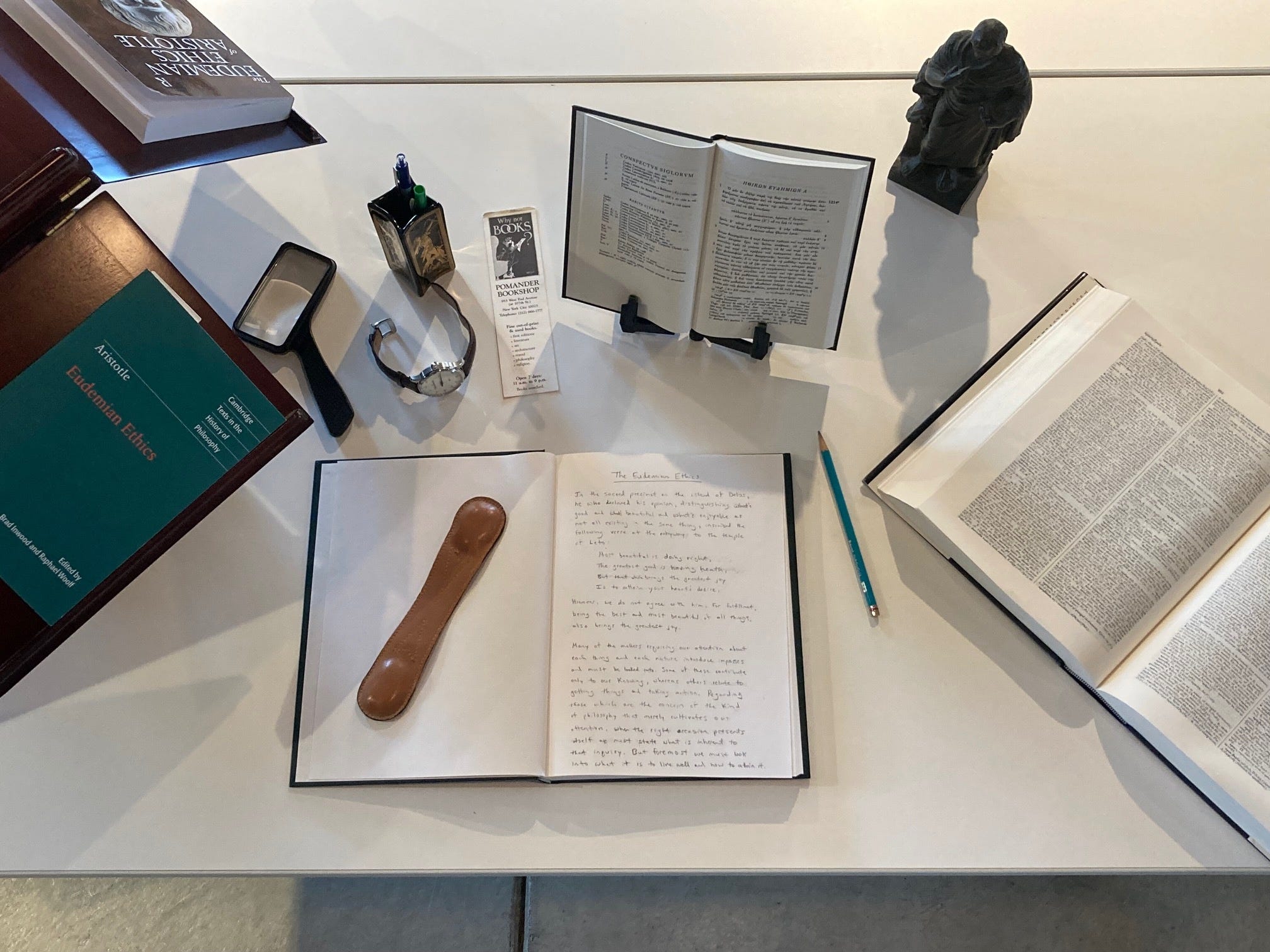
You might wonder: why in the world am I climbing this mountain?
I could say “because it’s there”, but that’d be a lazy non-answer. Kant is there too, but I’m not writing a book about his ethical philosophy or translating his Critique of Practical Reason.
I freely admit that, ever since I had a crisis of faith at the age of nine, I’ve been somewhat obsessed with becoming an ever wiser person. Over the years that obsession has manifested itself as a yearning to thoroughly encounter and learn from a few great thinkers who strike me as especially sagacious about the human condition and human potential. Some of those thinkers are not really accessible to me because I don’t know the language in which they wrote (e.g., Lao Tzu). Some thinkers whom other people consider to be great don’t resonate with me for one reason or another (e.g., Augustine, Sartre). Some thinkers intrigue me but don’t spark enough passion to justify a full encounter (e.g., Spinoza). Some thinkers are aligned with many of my own ideas but, I feel, lack the kind of surpassing profundity that is required for true sagacity (e.g., Eric Hoffer, Abraham Maslow). And so on. But if I were to create a Venn diagram of alignment, accessibility, profundity, and perhaps a few other properties, one thinker would land right in the middle: Aristotle.
That’s not to say Aristotle got everything right (whatever that might mean) or that I agree with him about everything (after all, agreement is overrated). It is to say that his writings have endlessly repaid the admittedly significant investment I’ve made in reading them (and now translating one of his thornier works from Greek into English); in particular, I’ve found that reflecting on his insights and applying his methods of thinking in my own life have been immensely generative of whatever wisdom and sagacity I’ve been able to attain.
So here I am, still climbing Mount Aristotle. As I approach the summit, the trail grows fainter, the terrain grows steeper, and the air grows thinner. Thus I expect that the last two chapters of my book will emerge more slowly (perhaps much more slowly) than the first four. The writing itself is straightforward because words come easily to me once I figure out what I want to say, but the process of research and reflection is intense.
Wish me luck, flatlander! ;-)