
Brief Translation Update
More on the Eudemian Ethics

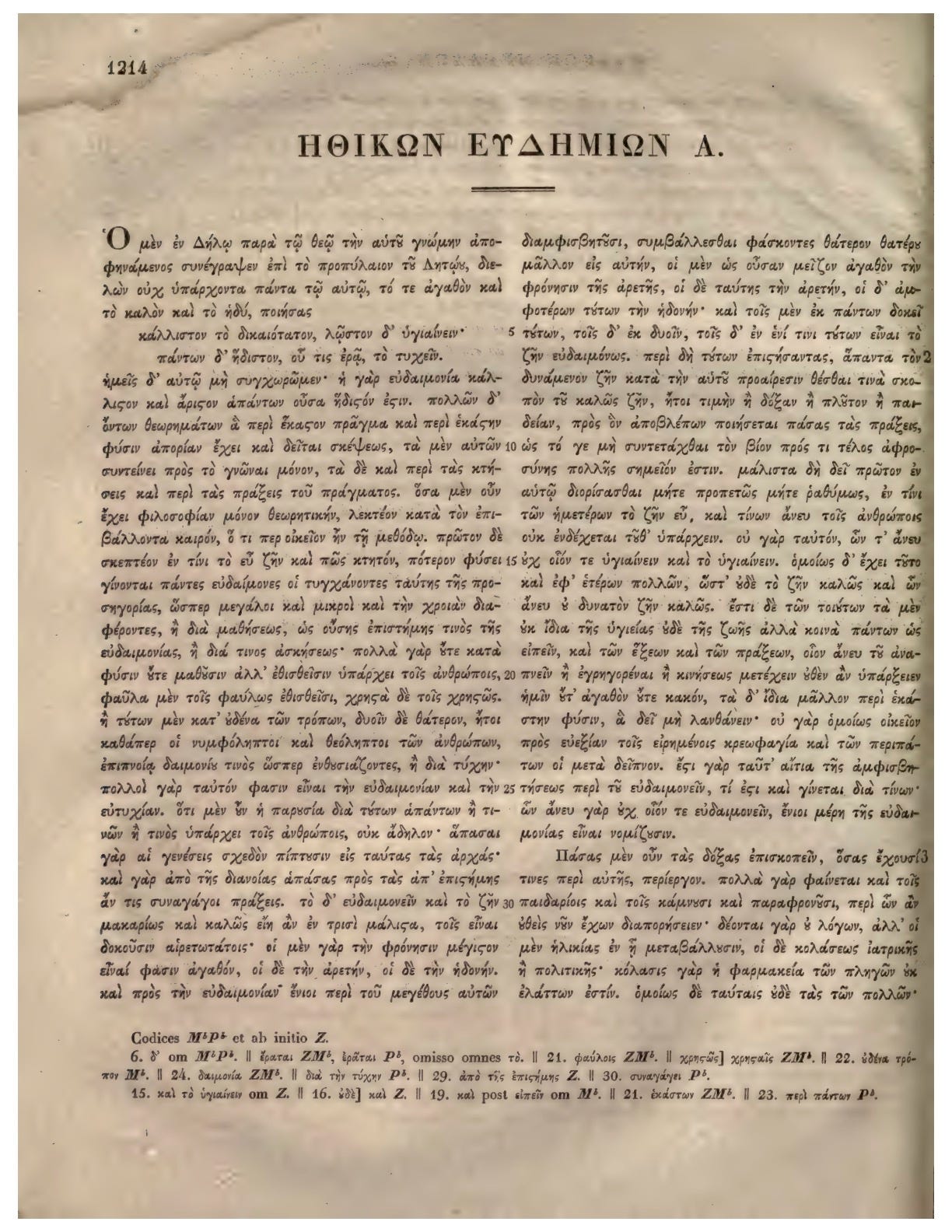
Well, it took me about 8 hours over the course of a few days to translate the first page of Aristotle’s Eudemian Ethics. Because there are 60 pages in the EE, as it’s affectionately known (including the three “common books” shared with the Nicomachean Ethics), at this rate it should take me about 500 hours to complete the translation. That’s not as long as I expected, and I’ll probably gain speed as I make progress up the mountain because here at the start I’m thinking carefully about how I’ll render certain words and phrases.
For example, on the very first page we find the following phrase: φιλοσοφίαν μόνον θεωρητικήν. Translators usually render that as something like “purely theoretical philosophy” but to my mind that kind of thing doesn’t capture the likely thought behind the Greek words (we can’t check all this with Aristotle, so we have to make informed inferences). In the fourth century BCE, philosophy was a new thing in the world and referred to “the love and practice of sagacity”; furthermore, the word θεωρία didn’t mean “theory” in our sense (any more than ἐνέργεια meant “energy” or φαντασία meant “fantasy”), but I think instead meant something like “attention”. Thus rather loquaciously I’ve provisionally rendered the phrase as “that passionate practice of sagacity which is devoted to attention alone”; this provides a fitting contrast with the fact that the EE focuses on that passionate practice of sagacity which is devoted to living beautifully and finding fulfillment. I freely grant that in this case I’ve used quite a few English words to unpack three Greek words, but (a) Greek is a terse language, especially in Aristotle’s hands and (b) I’m working hard to make Aristotle’s meaning truly understandable for modern readers.
By the way, when I say “page” I mean two columns of the Greek text as edited by August Immanuel Bekker in the 1830s. Although naturally I am closely referencing the most up-to-date scholarship on the Greek text, if you ask me the Bekker version is a thing of beauty.
The issue of how to translate ancient Greek is huge. The first translation I read of "Outlines of Pyrrhonism" was by Annas & Barnes. My reaction was that it was very interesting. I then picked up Mates' translation. It was hugely different! Mates leaves all of the difficult-to-translate terms untranslated. The reader must decide what they mean. With this, I *got* what Sextus was trying to convey.
Very interesting…. Is this to say something along the lines of what we might call “contemplative practice” or a contemplative life…. And that translators have rendered this as “theoretical philosophy”? That would be rich…. So much gets passed through an intellectualistic filter in the modern day….